Streamline Building Maintenance with Cleaning Robots | Failure-Proof Selection and Operation Methods
The building maintenance industry is currently facing structural challenges of severe labor shortages and rising labor costs.
Cleaning robots are gaining attention as a key solution to break through this situation, but hasty introduction carries significant risk of ending in 'unmet expectations'.
This article thoroughly explains specific 'selection methods' and 'operation techniques' to successfully introduce robots in building maintenance sites.
We will delve into common failure examples, optimal selection processes, and usage cases to maximize value—let’s explore the details.
Common Failures in Robot Introduction in the Cleaning & Building Maintenance Industry
Choosing the wrong model can turn an expensive cleaning robot into an unused 'ornament' on-site.
First, let’s understand three common failure patterns that many companies tend to fall into.
1. Choosing Based Solely on Price
Selecting a cheap robot solely to reduce introduction costs often fails to meet on-site requirements.
For example, low sensor accuracy is common in inexpensive products.
If the robot frequently stops because it cannot avoid obstacles well or collides with walls and furniture, you will ultimately need to monitor it, failing to achieve labor savings.
Additionally, there are cases where poor software prevents complex route setting or results in low cleaning quality that requires rework.
It is necessary to assess not just the initial investment, but also long-term operating costs and the essential value of whether the original goal of 'labor saving' can truly be achieved.
2. Focusing Only on Hardware Performance
Specifications like suction power and operating time are certainly important, but they are not sufficient.
In building maintenance work that manages multiple facilities over a wide area, the existence of software—a so-called 'control tower'—that enables remote centralized management of each robot’s operating status is indispensable.
Without this 'control tower', you cannot understand the situation when an error occurs without visiting the site, leading to delays in recovery.
Furthermore, cleaning completion reports require on-site staff to manually create daily reports, so the administrator’s workload does not decrease at all.
The key to success is to have a perspective not just on the 'individual' power of hardware, but also on the 'system' of software that optimizes the entire operation.
3. Neglecting Post-Introduction Support
Robots are precision machines that operate daily, so troubles can occur.
In such cases, situations like 'unable to reach customer support' or 'repairs take weeks, halting work in the meantime' are fatal from a business continuity perspective.
Particularly important is continuous support such as parts supply and software updates.
In addition to a 365-day call center and on-site maintenance system covering the entire country, the manufacturer’s reliability—whether they will continue their business stably and provide support in the future—is an important selection criterion that should not be overlooked.
Optimal Robot Selection Process for Building Maintenance Cleaning
To avoid failure and select the best model for your company, three perspectives are important.
1. Clear Cost-Effectiveness
First, accurately understanding the 'on-site' environment where the robot will operate is the starting point.
When EyeWise Robotics makes proposals, we judge the optimal model based on the following points in particular.
・Area and Aisle Width:
Is operating performance suitable for the scale, from small offices to large facilities of tens of thousands of square meters? Can sufficient aisle width be secured?
・Floor Material and Cleaning Quality:
Is it compatible with floor materials such as carpet, tiles, and long sheets? Can it achieve 'minimal water residue' that professionals value?
・Floor Configuration:
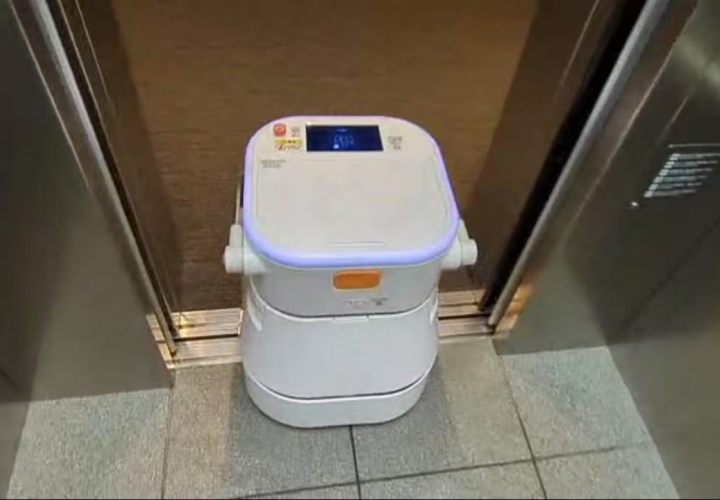
For buildings spanning multiple floors, an 'elevator linkage function' that allows the robot to move between floors autonomously is essential. This enables fully unmanned nighttime cleaning without human intervention, maximizing labor-saving effects.
2. Select by Remote Management System Functions
To maximize operational efficiency, focus on the functions of the management system.
Ideally, you should be able to grasp the cleaning status of all managed properties accurately and without stress from a PC or tablet.
・Centralized Management and 'Visibility':
Can you manage the operating status and schedules of multiple units on a single screen? If cleaned areas are color-coded on a map to 'visualize' work progress, progress management becomes much easier.
・Automation of Reporting Work:
A function that automatically creates and downloads cleaning daily reports dramatically streamlines reporting to customers, enables transparent service provision, and strengthens trust relationships.
・Flexible Task Setting:
Whether flexible task management is possible according to on-site conditions—such as detailed setting of cleaning modes and time slots for each area—is also an important point affecting operational burden.
3. Select by Future Expandability
It is also important to have a perspective that does not limit the introduction purpose to just 'automating cleaning work'.
For example, models that can be equipped with display shelves or digital signage can also be used as 'advertising/promotional tools' in commercial facilities.
In fact, there is a case where a convenience store increased sales of specific products by 1.5 times by displaying and promoting them while cleaning.
This is a good example of how cleaning—a cost center task—has evolved into a profit center task that generates sales.
The 'expandability' of what additional value can be created beyond cleaning is also an important selection criterion for creating future businesses.
Robot Usage Cases to Enhance the Value of Cleaning & Building Maintenance
The optimal robot dramatically transforms the workplace. Let’s introduce specific success cases from three aspects.
1. Reduce Costs with Unmanned Nighttime Cleaning
Floor cleaning during late-night hours has high labor costs and makes it difficult to secure staff.
Robots equipped with an elevator linkage function can fully automate nighttime cleaning of multiple floors.
This significantly reduces not only direct late-night labor costs but also indirect costs such as recruitment advertising fees, hiring and training costs, and labor management expenses, contributing to improved corporate profit margins.
It also becomes possible to reinvest the generated profits into improving daytime services and staff treatment.
2. Improve Customer Satisfaction with Consistent Quality
Robots perform consistent, high-quality cleaning according to programming, without variation.
One building maintenance company reported experiencing quality improvement, stating, 'We were able to incorporate floor cleaning—previously only done during periodic cleaning—into daily cleaning workflows.'
Maintaining a consistently high level of aesthetics leads to increased trust and satisfaction from tenants and facility users. Simply set up a communication environment like Wi-Fi to start operation immediately.
3. Improve Productivity through Human-Robot Collaboration
Robots do not take away human jobs; they are partners that dramatically boost productivity.
While robots handle physically demanding large-area floor cleaning, staff can focus on higher-value tasks that only humans can perform, such as toilet cleaning and wiping furniture.
This also frees staff from simple tasks and enhances their expertise.
As roles evolve from 'cleaners' to 'specialized operators who manage and operate robots', we can expect increased job pride and motivation.
This efficient division of roles raises the overall service quality of the site to a new level.
Summary: The Right Cleaning Robot Creates the Future of Building Maintenance
There is no doubt that using cleaning robots is an extremely effective solution to the structural challenges of labor shortages and rising costs.
However, to maximize their effectiveness, you need the insight to select a model that truly matches your on-site needs, without being tempted by immediate prices.
One company that introduced robots said, 'Introducing robots while the business has financial leeway and gaining operational experience serves as a risk hedge for the future.'
It is too late to rush into introduction after labor shortages occur.
In the future, as smart buildings become more prevalent, infrastructure that facilitates robot operations will become even more advanced.
The optimal cleaning robot is not just a 'machine'.
It is a strategic investment to reduce staff burdens, improve service quality, and strengthen corporate competitiveness—creating the future of building maintenance.
With an eye on the upcoming robot-friendly society, now is the time to take that first step.